
Salvador Ibanez (Lady's model)

Salvador Ibáñez (1854-1920) was a Spanish
luthier. He made guitars, ukuleles, mandolins
and other stringed instruments. These
instruments were considered the finest of
their age and are prized for their excellent
quality and impeccable workmanship.
At eleven years of age Ibáñez became an
apprentice in guitar construction at Calle Muela
Valencia. In 1870 he started his own company:
Salvador Ibáñez y Albiñara.
apprentice in guitar construction at Calle Muela
Valencia. In 1870 he started his own company:
Salvador Ibáñez y Albiñara.
The company was registered at Calle Cubells.
Working in his shop were the ten-year-old
José Ibáñez and Magdalena Albiñara y
Magraner, from Ollería, Valencia.
Working in his shop were the ten-year-old
José Ibáñez and Magdalena Albiñara y
Magraner, from Ollería, Valencia.
In 1896 he first appeared in the trade guides at
Calle Ruzafa Valencia and from 1898 to 1906
his shop was located at Calle Bajada de San
Francisco. Salvador Ibáñez made bandurrias,
lutes, six and nine-string guitars and also
guitars with detachable necks. In 1897 he
made the world's first double-necked guitar.
Calle Ruzafa Valencia and from 1898 to 1906
his shop was located at Calle Bajada de San
Francisco. Salvador Ibáñez made bandurrias,
lutes, six and nine-string guitars and also
guitars with detachable necks. In 1897 he
made the world's first double-necked guitar.
In the period 1915-20 Salvador Ibáñez e Hijos
(Salvador Ibáñez and Sons) were located at
Calle Bajada de San Francisco and at Calle
Padre Rico Valencia. When he died in 1920
his workshop continued to be managed by
his two sons until it was completely destroyed
during the Spanish Civil War (1936-1939)
in a bloody street fight, which cost the lives
of many of the personnel.
This was THE story up until now, however one of
my friends visited Madrid in order to meet some
colletors there and it became clear that at least one
of the sons of Salvador Ibanez didn't die in the civil
war and that the factory and its' machines were sold
to Telesforo Julve. A picture of a graveyard stone
from one of the sons from S. Ibanez attests:
DON SALVADOR IBANEZ SALABERT
DIED 21 abril 1967
A LOS 80 ANOS
R.I.P.
After the Salvador Ibáñez workshop had
(Salvador Ibáñez and Sons) were located at
Calle Bajada de San Francisco and at Calle
Padre Rico Valencia. When he died in 1920
his workshop continued to be managed by
his two sons until it was completely destroyed
during the Spanish Civil War (1936-1939)
in a bloody street fight, which cost the lives
of many of the personnel.
This was THE story up until now, however one of
my friends visited Madrid in order to meet some
colletors there and it became clear that at least one
of the sons of Salvador Ibanez didn't die in the civil
war and that the factory and its' machines were sold
to Telesforo Julve. A picture of a graveyard stone
from one of the sons from S. Ibanez attests:
DON SALVADOR IBANEZ SALABERT
DIED 21 abril 1967
A LOS 80 ANOS
R.I.P.
been destroyed and with the Salvador Ibáñez
guitars not being available (and very much
sought after due to their excellent quality),
the Japanese distributor Hoshino Gakki
decided to start making Ibáñez guitars of
their own after years of importing Salvador
Ibáñez guitars to Japan. They purchased
the trademark and started production, first
naming the guitars "Ibanez Salvador" and
later Ibanez which obtained great success
in the 1970s and 1980s.
guitars not being available (and very much
sought after due to their excellent quality),
the Japanese distributor Hoshino Gakki
decided to start making Ibáñez guitars of
their own after years of importing Salvador
Ibáñez guitars to Japan. They purchased
the trademark and started production, first
naming the guitars "Ibanez Salvador" and
later Ibanez which obtained great success
in the 1970s and 1980s.
Hoshino Gakki currently produces both
acoustic and electric guitars using the Ibanez
brandname and is oriented at all kinds of
devices for electric guitars and basses.
acoustic and electric guitars using the Ibanez
brandname and is oriented at all kinds of
devices for electric guitars and basses.
Julian Bream has played a Salvador Ibáñez
guitar. Eric Clapton has owned several original
Salvador Ibáñez guitars, one of which was sold
at a benefit auction in 1999 at Christies,
obtaining a final price of $42,000 USD.
The guitar was estimated between 3000 and
5000 USD what can be considered a fair
price on an auction. Regarding history it is
curious to discover that the first quality guitar
played by Francisco Tarrega was a Salvador
Ibanez before he switched to the Torres
guitar. A picture of Tarrega with a Salvador
Ibanez guitar seems to be around somewhere...
guitar. Eric Clapton has owned several original
Salvador Ibáñez guitars, one of which was sold
at a benefit auction in 1999 at Christies,
obtaining a final price of $42,000 USD.
The guitar was estimated between 3000 and
5000 USD what can be considered a fair
price on an auction. Regarding history it is
curious to discover that the first quality guitar
played by Francisco Tarrega was a Salvador
Ibanez before he switched to the Torres
guitar. A picture of Tarrega with a Salvador
Ibanez guitar seems to be around somewhere...
SOLD

As opposed to the front, the back looks
much better and indeed hardly any cracks
and that counts for the sides as well.

A nice shot of the brasilian rosewood back though
on some pics it may look a bit otherwise due to
necessary moves in a Photo program.

Dirty and still not taken care for on this picture
but clearly visible is the Bajada de San Francisco
label and not Salvador Ibanez e Hijos from the
later period. In this condition the guitar was offered
at the auction house Vichy Encheres in the South of
France. Careful inspection learns that an experienced
luthier can do the job.

The label here above has been used appr. from 1900 until
1905 according to Ton Bogaard who started the Telesforo
Julve site but he extended his search with other Valencia
based builders such as Ibanez, Andres Marin, Parres etc.

The head that is in good condition as well as the
fingerboard, frets and neck: The last one being
absolutely straight. Believe it or not:
To my opinion the original brass frets!

Allready cleaned for this picture the nice
and gracefully placed outer binding and of
course its rosette that is in good shape.
The biggest problem is restoring the outer
binding around the lower bout in a proper way.
The way the fingerboard looks is due
to lighten the darker parts in this picture.

A terrible sight for most guitar lovers but
even these damages can be cured. Some inner
soundboard struts are missing but the
discolouration of the wood where
they should have been makes it easier
to mark the places for copied ones.
Remarkable on this guitar is the three
piece soundboard as the 2 biggest "cracks"
in fact are no cracks at all but loosened
seams between the three parts. Luckily all
parts from the soundboard are still present.
The first thing to do is to remove the
back in a proper way which makes it easier
to repair the soundboard, strutting and little
glue blocks. A new endblock has to be made
and of course the outer lining that will
take most of the time. To be continued....

This picture is showing the repaired soundboard
as well as the glued sides for the purfling inlay.
One insert was necessary as clamping would
have asked too much pressure to bring the parts
together. The sounboard is perfectly flat now.

The strutting of the soundboard in the lower bout
had to be copied from the old ones. The two outer fan
braces are newly made as well. The endblock was
missing but the discolouration of the inner soundboard
made it easy to copy it according to the original one.
Next step is to place the back with two new transverse
bars. The back is in excellent shape and will be allmost
original when placed back on this instrument.

At this stage the Ibanez has been inlayed but it hasn't
been coloured yet up to matching the existing inlay.

The same with the back that received an entire edge
inlay though more simple according to the original.

The wood insert and the contour inlay has been matched with
the colour of the soundboard and existing inlays. I'm planning
to make a slightly action correction and probably mount a piece
of ivory on top of the bridge for better tonecolour and sustain
though it is not originally intended by Ibanez. These bridges
are making it possible to place a piece of ivory or bone just
behind the rim the strings are resting on. Always removable
and this move would even improve intonation!
Want to know more around this brand and in general
about the Valencia made guitars, just check this site:
www.guitarrasvalencia.wordpress.com
Jaime Ribot / Salvador Ibanez 1908

I'd like to start with the end result: The guitar as
it is now. Great bonus was the awesome tone!
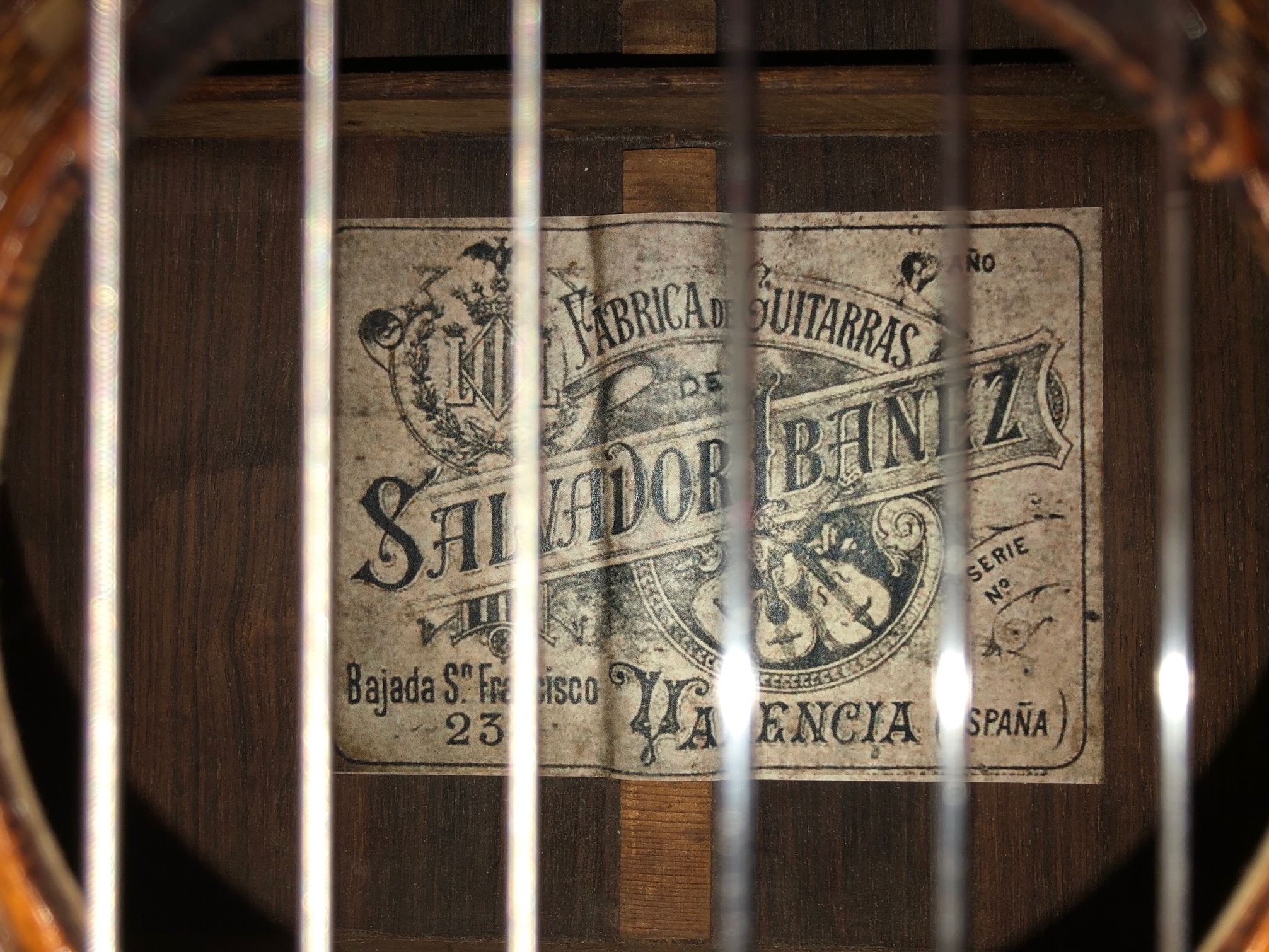
A newly added label. I'll explain this decision
further in my explanation, but the inside work
really points towards Salvador Ibanez.

The back that has been French polished as is the rest of
this guitar.

Only two small inserts in the centre of the bottom
were needed. Hardly detectable now.

As the back had to be taken off a new binding of course.

The soundboard, still absolutely straight before
and behind the newly glued bridge.

Half of the original frets were missing so a new fret job
was necessary. Also to change the angle neck to body.

Some mother of pearl pieces were missing. Newly added
of course. The two triangular inlays on both sides of the
bridge are not in line. Remarkable but I've seen this more
on Salvador Ibanez guitars!

The head with its' inlays. Again in a like new condition.

No damages to the back of the head. Not any cracks
here. Original tuners as well.

The typical Valencian way of building a heel.

In fact photographed to show the action. This guitar
is very comfortably playable now with its' 4,5 mm action
on the 6th string (twelfth fret) and 3 mm on the first.

Maybe even lower for the first string. A joy to play!

Just a nice shot but also to show the inserts alongside
the left and right side of the fingerboard though this
often occurs on older guitars.

A Brasilian rosewood fingerboard as opposed to the later
used ebony when Salvador Ibanez e Hijos were in charge
on their highest models.

All the repaired cracks can be seen here. I've left the
inserts just a bit higher so a luthier very experienced
in coloring the insert might do a better job.

The bridge already was partly loose and having seen the knob
for a strap (I do not know wether if this is original?) and
the holes for a string holder I presume someone putted on
a set of metal strings!

A beautiful rosette but in fact carved a bit too deep in the
soundboard. Therefore I strengthened the inner part
of the sound hole to prevent any future damages. That
can be removed but is not advisable.

I took the opportunity to remove the bridge a bit further
away from the sound hole to ensure a perfect octave pitch!

The knob for the G-string is a bit bowed but works perfectly.
Dangerous to have it placed back in the "start" position so I
left it that way as it works normally.

The guitar in question in unrestored condition.
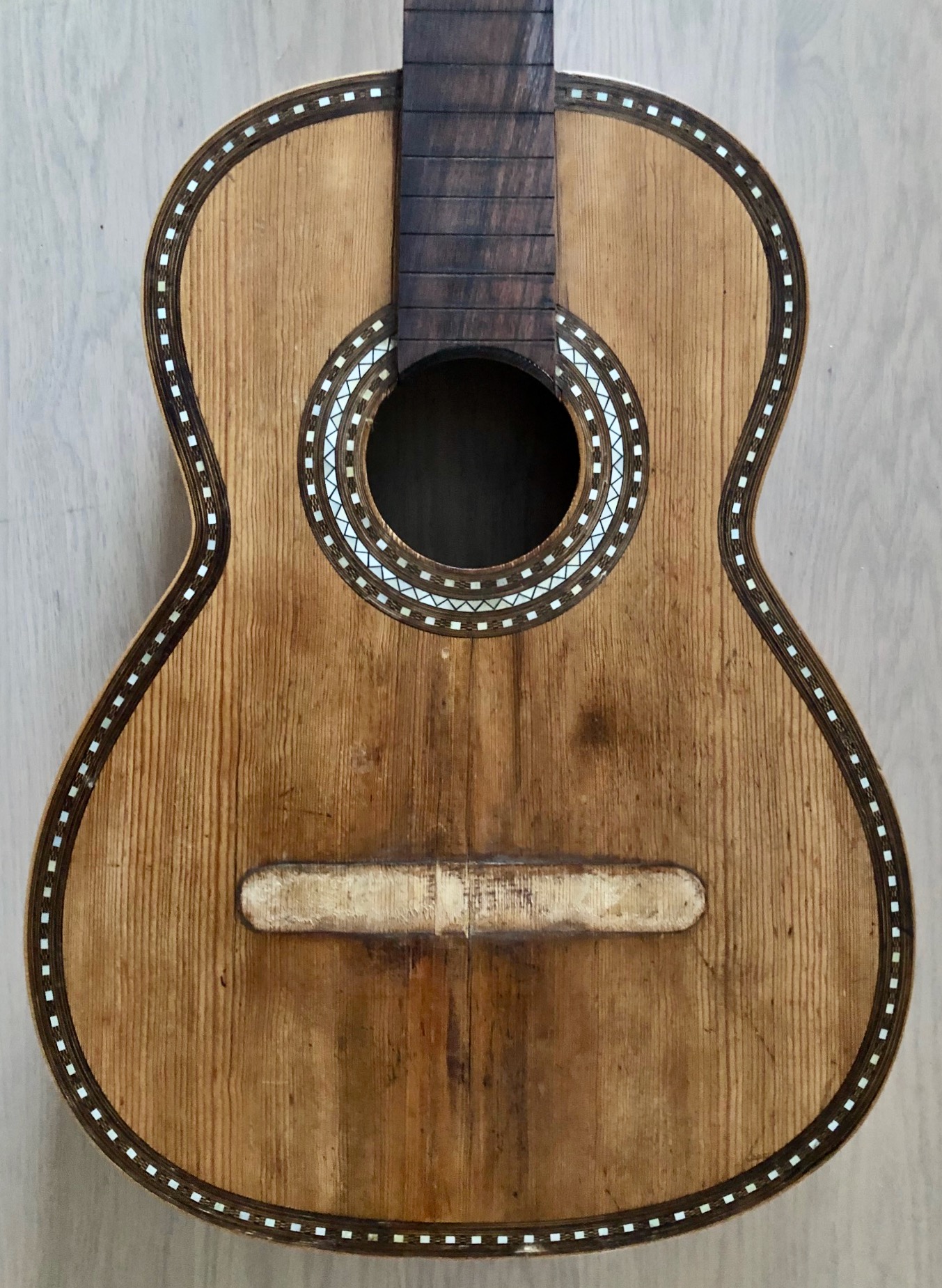
A body close up with the frets already removed.

Similarities with a Jaime Ribot guitar. But also with a Francisco
Pau guitar. It would have been easy to place a label in this guitar
from these luthiers but to be honest: everything points towards
Salvador Ibanez as I already explained here and there.

The Jaime Ribot guitar and other builders appear to
have similar ornamentations as on guitars of some other
Valencian makers they can be seen: Francesco Pau
and of course Salvador Ibanez.

The Jaime Ribot label, a bit damaged.

Again, but now with the strings in between. You can easily
make pictures with your mobile telephone by simply sliding
your telephone below the strings and then make a picture.
These pictures are NOT from the guitar in question!

The guitar presented with the bridge off as it was
easy to remove it. It was already partly loose.

The body before the crack repairings took place.

The label that should have been in this guitar. Photographed
and shopped to make it clearer thus giving more details.

This label must have been used between 1905 - 1910.

Some reparations (inserts) were needed and therefore
the back has to be French polished from the start.

A knob at the bottom intended for use with a holding
strap. Wether if this is original can be discussed of course.
The holes a bit higher placed are the traces of a formerly
placed tailpiece, probably for metal strings...

The inserts, still not colored to their surrounding.

Strange is the unevenness of the inlays on both sides of the
string tie block. I've noticed it on other guitars from Ibanez
guitars of that period. The inserts necessary can be studied
here. More easy to do that without the bridge glued on.

The head and the newly placed frets as half of them were
already missing and moreover, I had to make a neck to
body angle correction. For that purpose I shaved away
material of the fingerboard towards the head.

I've shortened the headstock with about 1 mm in order
to get rid of disturbing damages that occur when placing
a guitar frequently with its' head against a wall.

A new quality topnut that has to be
there on a concert guitar of this age.

Though the back has been taken off, a picture with the
label sticked in from the sound hole has to be there.

This happens so often! In this case the two transverse braces
were partly loose and then string tension can cause these
problems much easier. To prevent this in the future I placed
an extra wide but thin layer between the two transverse bars
in the upper bout. The Japanese do this often to prevent
these damages.

Another move was to strengthen the soundhole
edges as when the space for a rosette is carved too
deep it severely weakens that spot. The cleat
beyond has been placed at the end of a crack.

Every single glue block that attach the soundboard to
the sides must be checked and reglued if necessary. The
transverse bars above the sound hole had to be reglued.

And the same insert on the other side.
A knob at the borttom intended for use with a holding
strap. Wether if this is original can be discussed of course.
The holes a bit higher placed are the traces of a formerly
placed tailpiece, probably for metal strings...
The head and the newly placed frets as half of them were
already missing and moreover, I had to make a neck to
body angle correction. Fo that purpose I shaved away
material of the fingerboard towards the head.

No spruce heel operation, often done by Valencian
makers to speed up production processes.

And a picture of the other side of course.

The new added bindings around the back.

New proper fretwork.

A nice shot of the ornamentation and the Brazilian
rosewood fingerboard used here.

The insert on the right can be studied here.

Inserts coloured a bit better...

The beautiful rosette with some newly placed
pieces of pearl inlay.

The sides that are in pristine condition.
Salvador Ibanez e Hijos (appr. 1910)

This is another, somewhat later Salvador Ibanez guitar.
It is an easy conclusion as the label states: Salvador
Ibanez e Hijos, a label that Ibanez started to use from
appr. 1910. A neatly built instrument but still a lot of
work to bring it back to life again. It is a concert model
with the dimensions that go with that: a 650 mm scale.

A nice Brasilian rosewood back with some repaired cracks.
Cedar has been used for the neck that is still straight. The
action on this guitar wil be cured by shaving off the fingerboard
towards the head. It has two advantages: a better playing action
and the damages in the fretboard can be removed. And these
damages are allways present around the first two frets.

Curious on this bridge are the two inlays, later a trademark
for Telesforo Julve. In fact not strange as Telesforo Julve
took over the Salvador e Hijos workshop. Salvador Ibanez
(the father) died in 1920. The took-over took place some-
what later. One small crack can be seen just at the right.

As the crack on one side of the bridge still closes a
careful glueing process will do the job. Afterwards
two or three cleats will hold this crack and another
advantage is that the upper surface becomes per-
fectly straight again. As the bridge appears to be
quite heavy, I'm planning to sand it down in order
to give the top more possibilities to vibrate.

A bit of a Torres shaped head with square ending slots.
Width at the topnut is 51 mm. The nut is a bit crudely
made and will be substituted with an ivory one.

The knobs on the tuner appear to be from bone and
they are locked on the axes. They can be found on
almost all Salvador Ibanez guitars from that period
but also some workers that left his workforce builded
guitars in an identical way.

A nice shot of the heel which is typical Valencian in
shape. The lower part of the heel however is made
out of hardwood as well though the cheaper solution
in Valencia was to install spruce or another softwood
to speed up the building process.

Presented here is the label ftom this guitar.

For an even better impression: The same label found
on internet.

A rather small rosette in width made with concentric
circles and inlayed with mother of pearl pieces. Salvador
Ibanez more than often worked with remarkable big ro-
settes but in fact a big rosette influences the sound in a
negative way as it stiffens that part of the soundboard.

Sides that are still in a pristine condition. The yellowish
color is a result of the varnish that has been used and
over time gives this color on Brasilian rosewood. A
new lacquering process would give this guitar a
much darker and deeper coloured appearance as
can be seen by studying the back after a refinishing
process: The result is a much darker colour.

The first cleaning process allready took place but some
discolourations around the bridge still have to be removed.
After that and the reparation of the crack near the bridge
the entire soundboard will be treated with a special liquid
to remove the dicolourations that still can be determind
at the moment. It is still absolutely straight probably
due to the bowed construction.

The relacquered back that shows the old beauty again
of the Brasilian rosewood. The original lacquer colours
the wood in a yellowish way but had to be removed as
some restorations were not properly executed. Always
trying not to sand the wooden parts of the soundbox!

A nice shot of the newly finished back

And the difference in colour compared to
the sides that have their original lacquer.

On this picture the fretboard has been shaved allready.
Afterwards new frets were installed and the cleaning
process of the soundboard is in a "second" stage

As the sleeves for the tuners were a bit crudely done that
could be fixed as well. Relacquering of the head after-
wards in fact was a must but again: The beauty of the
wood is there again to its' full potentials.

Second cleaning job before the first playing trial on
this guitar. After restringing a guitar that was not
under tension for a long time means that you have
to wait a few days to be able to judge the sound of
an instrument. Adjustments can be made once some
elements are not accordingly your wishes. Especially
the bass tones can be boosted by thinning the sound-
board a bit along the edges.

So nice to see the wood again in its' beauty.

This picture has been taken to be able to study the colour
differences after the relacquer job on the back.


The crack that has been glued and provided with three cleats
inside. The split in the two halves is covered by one of the
7 fan braces. That will do the job.

A new ivory nut after the fingerboard has been shaved
towards the head and the new frets allready mounted.

Not all imperfections of the soundboard have
disappeared but for a 100 year old one it is
in a very nice condition again.

The square filed slots for the tuners can be studied
here. The neck has been left the way it was.

As the wood on the head has a beauty of its' own
only a sanding and refinishing job will do.

The inner heel has been inscribed with Salvador Ibanez
e Hijos -Valencia. Only visible from the inside of course.

The cleaned tuners that in fact are quite simple but
they still do their job in a sufficient way!
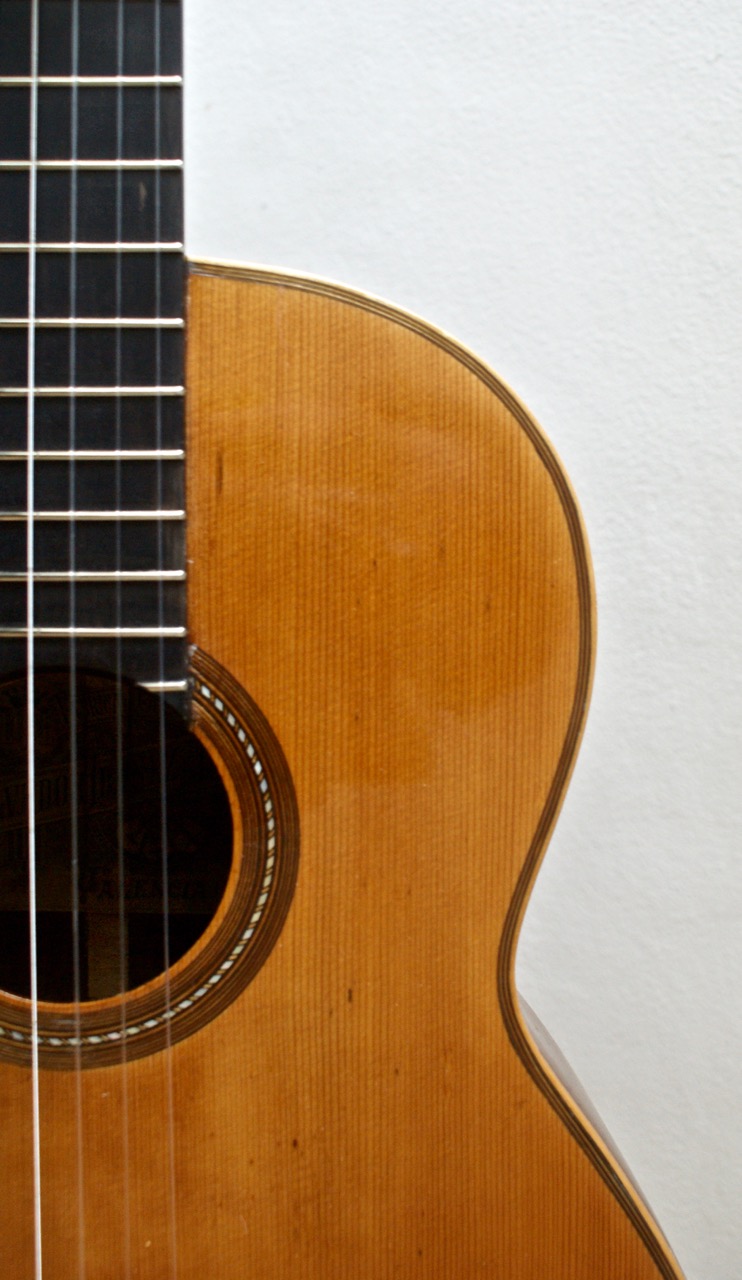
A rather small rosette but a tasteful one to my
opinion as opposed to the earlier quite ornamented
ones. A smaller rosette is better for sound results!
Salvador Ibanez e Hijos (Intermediate model)

This guitar is not part of my collection but I'll include it as
Salvador Ibanez e Hijos labelled guitars aren't always "high
end". This one came to me from a friend of mine who was
curious to find out the qualities of this guitar as sometimes
the more simple instruments can be surprisingly good.
Of course the filed copper frets are a sign of a lower end
instrument but equipped with a nice rosette and a 5
fan bracing for the top it is not a "beginners" instrument.
As is often the case with these Valencia built guitars
this one is provided with a three piece soundboard. Most
likely a cost saving move and not because Antonio de
Torres built guitars with a 3 piece top.

The bridgebone (plastic!) was lowered that much that
the strings didn't make any angle over it and even in
spite of that fact, it still sounded good! A heavy bridge
is not good for a good sound production. This one was
too thick and the sleeve for the bridgebone was really
not deep enough. I think to have won about 4 mm by
working on both elements: Lowering the bridge as a
whole and deepening the sleeve.

Moreover the holes closest to the bridgebone were too
high, thus making any angle almost impossible. I lowered
the stringtie block and removed the upper holes. A new
layer of veneer was a must then and why not adding a
personal touch as Ibanez started with the two inlays one
can find later in time on almost all Telesforo Julve
guitars. Abalone has been used for that.

When you reglue a bridge the compensation for a correct
octave pitch is the first thing to go for. So here you can see
I was forced to replace this original bridge 2 mm back-
wards in order to have a correct pitch. The bridgebone
will be set to the proper hight once the strings are under
the correct tension. Every neck seems to behave in its'
own way, bending slightly forward.
Want to know more around this brand and in general
about the Valencia made guitars, just check this site:
www.guitarrasvalencia.wordpress.com
Salvador Ibanez guitar from around 1900


To present this guitar I will do the accompanying text in English.
Very little can be found on the Internet and even AI only tells us
the story my friend, Ton Bogaard already wrote on his site:
guitarrasvalencia.wordpress.com where a lot more can be found
around the several luthiers that were active there. This example
certainly is one of them but when you know that a lot of parts
and even ornamentations were ordered at companies specialized
in this sort of "guitar additions" it remains difficult to give a
guitar its' final place and origin. Scale: 640 mm Width topnut:
50 mm. Body's own frequency: G# = 104 Herz.

A "luthier" called Pedro Talavera could be responsible for the
building of this guitar but assumptions are already there that
these Talavera labelled guitars are coming from Salvador
Ibanez, Jose Parres or even Jaime Ribot. When the inner
wood work of those luthiers can be studied we can possibly
say a bit more.

A good friend of mine who is a good photographer "repaired"
the label to a very useful one. Besides the missing corner the
riss near the centre of the label (due to a crack in the back)
has disappeared. Simply great work!

To my opinion this is an outer heel form that the Valencian
luthiers often made during the existence of the Salvador
Ibanez workshop and later with his sons.

As I stated earlier sometimes a company gave exclusive rights
to an importer or exporter and to avoid legal problems a kind of
"fantasy name" not really existing, was put on a label. Moreover
on this "Pedro Talavera" label there is no adress to be found
which is of course remarkable and in fact underlining the
supposition that it is a "fake" label most likely used by "Hees",
a Dutch company that were selling several guitar brands.

For a 125 year old guitar it is remarkable that the soundboard
is completely crack free! Cleaning it and maybe give a few
layers of French polish will do the job.

These are some of the more severe problems I will have to deal with:
A lot of cracks in the back. Maybe veneering could be the solution.
Or replacing? I will discuss that the coming week with some people.

As there are too many cracks on the back I figured the first step would
be to remove the back and inspect all the glue work, also from the
soundboard. A very strange way of placing the glue blocks, though!
I will come up with more pictures regarding that move.

A rather wildly figured back. Beautiful for people that are less
interested into construction as these backs are more prone to
cracking. The rather "dull" (or straight) figured backs will hold
much longer. The heel on this guitar however is more rounded
as opposed to the heel on the 1900 Siccas example.

You can click on this picture to study the beautiful inlays
of which only one piece is missing! Exactly this rosette can
be found on a Siccas sold Salvador Ibanez guitar from 1900
As often! Steel strings were mounted on this guitar.
Never do this as a steel string set will pull on the bridge
with almost two times the force of a nylon string set,
around 75 kilograms.

A centre inlay that stops when reaching the top.
Most of the time the inlay is all the way up! On the
Siccas sold Salvador Ibanez from 1900, the ornamen-
tation also hasn't been inlayed to the top of the head.

And here is the combination with the bridge that has been lowered
but can be restored to an almost original looking bridge of that
time. The soundboard has been equipped with a 5 fan bracing.

To date this guitar even more exactly: The inlay on this bridge
can be found most of the time on guitars around 1900. The square
outer ends were a bit later invariably replaced with rounded outer
ends. When the sons of Salvador Ibanez were in charge, the return
to the square appearance was done. To be continued.

This picture has been taken from a YouTube video that
is about the restoration process of a Salvador Ibanez.
The slightly slanted transverse bars immediately will
raise questions, especially when luthiers are involved.
The label on the guitar on this picture also dates this guitar
to be from around 1900 as the exact year has been written
on this label. As the guitar here above is a so called
"Resonator" guitar, it has been mentioned on the label.
It would be better to give my guitar a 1898 - 1902
label when Salvador Ibanez also was busy on the
Bajada de St. Francisco 23. But at first I will be certain
this Pedro Talavera guitar is really coming out of the
Salvador Ibanez workshops. but let us not forget that
several employees in the past worked further on their
own by learning the craft at the Ibanez workforce. To
name Frederico Pau who later delivered instruments
to Telesforo Julve. And also Juan Ponce made
instruments that were exported to the north of Europe
by Jose Cortes. He also built that typical high end
Valencian guitars in the traditional Salvador Ibanez
way as probably did quite a few others at that time.

An example of a guitar built in this tradition: A Julve
high end guitar built by Juan Ponce (?)


And here the guitar, presented with its' back off.
It will be possible now to check all the glue work
but to prevent future problems some extra moves
have to be made. Though this top is completely
free from cracks as often most of the time some
problems at both sides of the fingerboard in the
soundboard may occur in the future, especially
when the transverse bar closest to the heel hasn't
been sturdy glued anymore. A small second bar
will be added. The sound won't change. I will also
equip the sides with some braces here and there
and inspect and if necessary, reglue some glue
blocks. A new glue strip for the back is of
course inevitable. According to the tradition
in those times it will be a non carved strip.

As I've mentioned earlier the slanted bars on the back.
Though the guitar possibly receives a new back in the
near future, I will securely replace these bars the way
it has been done on the old back. A possibility is the
veneering of a new piece of wood with this old back.
It is always advisable to keep the transverse bars on the
back (and front) a bit shorter as when temperature changes
are involved they will expand and thus damage the sides.

Only one repair on this side of the guitar, a bit clumsy
done with paper (!) but what is immediately noticeable
are the glue blocks. The alternate placement of the glue
blocks I already knew from the Telesforo Julve guitars
but this is even more work and possibly could have
influence on the freely vibrations of the soundboard
to my opinion. A befriended luthier suggested it could
have been done to strengthen the soundboard as the edge
inlays are quite big in width. Those longer strips glued
to the soundboard can also be seen in the Salvador
Ibanez guitars but here these blocks have another
glue block placed on top.

Alass, a bit damaged during the back removing process.
I can have it cured as a girlfriend of mine is really good
at digital repairing this label. A "complete" label will
be delivered with the sell of this guitar.

The form of the inner heel block can also tells us a
lot about who actually built this guitar. To my opinion
exactly the same as sculpted in the Salvadore Ibanez
guitars of that time.

The endblock is much too thin to my opinion as are the
glue strips for the back. As this is the possibility to make
a real neck reset, glue work has to be done in a proper
way. By diminishing the distance inner heel / end block
you are able to change the angle neck / body and thus
you can create a very well playable guitar without
having to change the fingerboard and fretwork. In fact
we're talking about a neck reset.

OK, on the picture it all looks still reasonable but in
reality I doubt if I can reuse it. When making a neck
reset the plantilla will be slightly different so I will
need some extra pieces to cure that. Maybe too much
work and what will be the result? I do not expect
a new back will diminish the sound qualities.

Some side reinforcements to prevent problems (and cracks)
in the future. Also an extra transverse brace has been placed
above the original one that is glued just above the soundhole.
When that brace loosens it more than often happens that
the soundboard is developing cracks alongside the
fingerboard. In present times most builders are placing
such an extra brace to prevent those damages due to the
tension in that area, most of the time even wider executed.
Also some soundboard braces have been reglued. Making
everything free from glue traces caused by spilled glue is
in fact not necessary but gives a much neater appearance.

I've made the glue strip for the back a bit more wide in order
to compensate the changed plantilla that occurs when removing
the back. Making a wider centre strip was an option that came
to my mind but then all the inner (original) woodwork around
that centre part of the back would have to be renewed. I did
this move on an old Juan Estruch guitar and with success.

It remains a bit strange: This way of placing the glue blocks
for the soundboard and in fact labour intensive. It must
have been an experiment from one of the workers at the
Salvador Ibanez workforce and maybe therefore this guitar
has been provided with a "Pedro Talavera" label (?) but also
on the Salvador Ibanez guitar with a wider edge inlay the
extra length glue blocks on the soundboard are present.

As I was forced to make a neck reset some extra glue
surface on the endblock was advisable to my idea.
Therefore I've thickened that part a bit.

And yes, I've decided to keep the original Brazilian /
Indian rosewood back as it is a part of this guitar and
history around the Salvador Ibanez workshop.
During restoration it is always good to make pictures.
So here the repaired back has been reinstalled, with a
serious neck reset in mind. It is a tedious process to do
it the right way. I had to make some extra tools before
I've glued the repaired back to measure the distance
between the heel and the endblock that was enough to
finally give this guitar a good playing action.

Here and there it will be necessary to glue some splints
of wood to the surroundings to fill out the 'spaces" here
and there. The slightly wider glue strip for the back
enables me to reduce that to the minimum.

Some cleaning sessions with alcohol will clean the sound-
board before some final French polishing layers will be
applied. The bridge here has been remodeled as some-
one replaced a part of it but did that in a bit clumsy way.
However, it was a wise decision to built in a sort of
octave compensation to keep the guitar in tune,
especially in the higher positions.

The first layer of shellac liquid. Of course the final result on
both sides and back will be much darker and most likely in the
way it was when the guitar was just finished. Over time these
lacquers are becoming more yellowish in appearance.

I've checked the neck / body angle securely and the guitar
can be played now with a nice action. The strings are already
mounted and an experiment with different brands of strings
made it obvious that it results in a lot of difference in tone

What a nice view on a hundred and twenty year old
guitar. Some missing pieces of pearl along the edge
have been replaced during this restoration.

The back needs a final polishing turn but it is better to wait
when the layers of French polish have been hardened out.

Even the back is in a good condition again.
With a good eye detectable repairs of course
but absolutely satisfying to my believe.

With strings on. You want to check playability and
when needed lowering the bridgebone. That wasn't
necessary. I have changed the topnut for a better
spacing but I will keep and supply the original
topnut for the future owner of this guitar

Heart of this instrument is of course the undamaged
soundboard. I've decided not to put any label in this
guitar but I can prove the "Pedro Talavera" label
was in this guitar. However, too much specific S.
Ibanez building features are pointing towards this
luthier so a time correct label will be supplied as
well. Maybe place both labels in this guitar?

Heart of the problems was the cracked back for me as
a restorer. But removing it gives you two advantages: All
the glue work inside can be checked and if necessary
reglued. The traverse bars along with some cleats will
ensure a stable back again.

By clicking on this picture you can even enlarge it.

In the times (around 1900) when this guitar must have
been built, luthiers didn't built in a compensation for
a correct octave pitch (12th fret) That was for two
reasons: The playing action on these old guitars was
much lower and that all along with other strings.
Another restorer corrected this and I gave it a more
natural look afterwards as it is here on the picture.


The head received some layers of French polish as well.
A remark should be made around the tuners as they are
as old as the guitar itself (time correct) but do not belong
to this guitar as they are different from each other. For that
reason they also work in a different turning direction.
People that are aware around the mounting of tuners will
even notice that the worm gear should be placed in front
of the gear wheel, so the other way round as can be seen
here. That was customary until about 1910 / 1920.
Mechanically spoken, this works much better. On the
picture right the extra "shaved" lower outer end of the
sleeves can be studied: Exactly the way you can see it on
the genuine Salvador Ibanez guitars.

I always add this picture to show that these frets
will serve the future players for years to come. But the
more critical player maybe favors a bit higher frets
with steeper fret ends. Often the fret ends are rounded
for a more pleasant feel but with pull offs played on
the highest string a finger more easily slips of the
fingerboard. The new top nut placed by me has a
better spacing especially for the lower strings.
Again the back of this guitar as the name of the retailer
(from The Netherlands) can be seen here: Hees & Cie.
Internet will provide you with even more information
around this music retailer. Furthermore I found out that
Hees imported guitars from Vicente Parres and it is
possible that that luthier is responsible for this guitar
as well as he also built these highly ornamented
guitars in his career.

Geen opmerkingen:
Een reactie posten